Top Features to Look for in a Kangen Water Machine
Anyone researching a Kangen water machine in India is usually trying to solve the same problem: how to get consistent, ionized alkaline water at home without guessing whether the investment is worth it. Here's what most buyers don't realise going in — Kangen water and alkaline ionized water are, technically speaking, the same thing. Both are produced using identical electrolysis technology, where filtered water is passed over titanium plates to separate it into alkaline water for drinking and mildly acidic water for external use. The name "Kangen" simply refers to one brand's version of this process; the water chemistry and health benefits it produces are shared across the entire alkaline ionizer category.
This matters because it changes how the buying decision should be made. Rather than searching for one specific brand, it makes more sense to compare machines on the features that actually determine performance — plate count, hydrogen output, ORP, certifications, and after-sales support.
This guide breaks down the core specifications and buying factors that separate a genuinely capable water ionizer from a basic one, so buyers can evaluate any machine with confidence — whatever brand name is on the front.
Why Feature Comparison Matters More Than Brand Name
Because Kangen water and alkaline ionized water rely on the same underlying process, the real differences between machines don't come from the brand name — they come from build quality, plate technology, certifications, and long-term performance. A Kangen water purifier, like any quality alkaline ionizer, works by running filtered water over platinum-coated titanium plates, where electrolysis splits it into alkaline and acidic streams. Two machines using this same core process can still perform very differently depending on plate count, water settings, and how well they're built to handle daily use.
Buyers comparing options — including alkaline ionizer brands like Chanson, which is built on the same electrolysis technology at a notably lower price point — should evaluate machines on the same technical criteria used for any medical-grade water appliance, rather than defaulting to whichever name is most familiar.
Key Features to Look for in a Kangen Water Machine
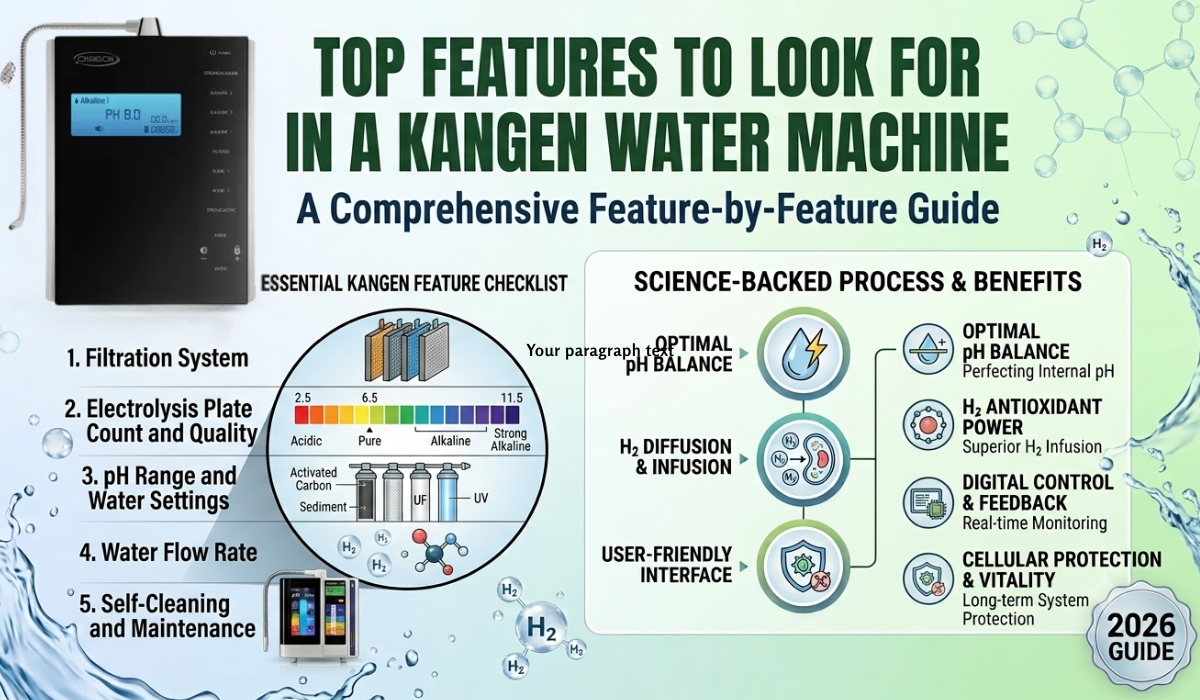
1. Filtration System
Filtration is one of the first things to evaluate because the water is filtered before it reaches the electrolysis chamber.
A good Kangen water machine should have a clearly specified filtration system rather than simply claiming to “purify” water. Buyers should check what the filter is designed to reduce and whether the manufacturer provides information about the filter media, capacity and replacement interval.
Depending on the model, filtration systems may target substances such as:
Sediment
Residual chlorine
Certain heavy metals
Organic contaminants
Microorganisms
Other impurities specified by the manufacturer
For example, Chanson's current product information describes four-stage filtration using materials such as activated carbon and other filtration media, with some models specifying a 9,000-litre or 12-month filter life, whichever comes first.
However, filtration performance should not be judged by micron rating alone. A smaller micron number does not automatically mean that a complete filtration system is better. Buyers should consider the filter media, contaminant-reduction claims, capacity, flow rate and relevant testing or certification.
Most importantly, filtration and ionization perform different functions. Ionization does not automatically mean that all contaminants have been removed from the incoming water.
2. Electrolysis Plate Count and Quality
The electrolytic plates are among the most important components in a Kangen water machine because they are directly involved in the electrolysis process.
Machines can use different numbers of plates, such as:
3 plates
5 plates
7 plates
9 plates
More plates do not automatically mean that one machine is better for every buyer. Plate configuration is one part of the overall electrolysis design, and the appropriate choice depends on the machine's intended usage, flow rate, water conditions and specifications.
The plate material also matters. Many premium ionizers use titanium plates with platinum coatings. Chanson, for example, specifies platinum-coated Japanese titanium plates across its current ionizer range.
Buyers should therefore look beyond a simple “number of plates” comparison and also check:
Plate material
Coating technology
Plate dimensions
Electrolytic cell design
Manufacturer specifications
Cleaning technology
Warranty coverage
A higher plate count can be useful for higher-demand applications, but it should be considered together with the machine's complete design.
3. pH Range and Water Settings
The pH range is another important specification when comparing a Kangen water machine.
Different machines may provide several preset water settings, allowing the user to select different alkaline, neutral or acidic outputs.
A machine may provide settings for:
Alkaline drinking water
Neutral or purified water
Mildly acidic water
More strongly acidic water for specific household applications
A wider advertised pH range gives the user more adjustment options, but a wider number alone does not automatically make a machine better.
Buyers should check the usable operating range for each setting, rather than focusing only on the maximum and minimum numbers shown on a specification sheet.
It is also important not to assume that every acidic-water setting is automatically suitable for sanitization or disinfection. Actual antimicrobial effectiveness depends on factors such as water chemistry, pH, oxidation-reduction conditions, available chlorine and contact time.
The right question is therefore not simply, “What is the highest pH this Kangen water machine can produce?” Instead, ask whether the available settings are appropriate for the buyer's intended use.
4. Hydrogen Generation
Hydrogen output is increasingly used as a specification when comparing an alkaline water ionizer.
Manufacturers may report dissolved molecular hydrogen concentration in parts per billion (PPB). A higher reported hydrogen concentration can be an important technical specification when comparing hydrogen-generating ionizers, but the figure should always be evaluated under the manufacturer's stated operating conditions.
For example, current Chanson specifications list hydrogen output of up to 1,200 PPB for some Lite models and up to 1,600 PPB for several 7- and 9-plate models.
However, buyers should avoid treating a PPB number as a direct measurement of health benefits.
When comparing a Kangen water machine, check:
Maximum stated hydrogen concentration
Water setting at which the measurement is achieved
Flow rate during measurement
Testing methodology
Whether the number is measured at the outlet or under another condition
Whether the manufacturer provides supporting technical information
This makes hydrogen output a more meaningful specification rather than simply another marketing number.
5. Understand ORP Separately From Hydrogen
ORP, or oxidation-reduction potential, is another specification commonly shown on alkaline water ionizer product pages.
It is measured in millivolts (mV) and describes the oxidation-reduction potential of the water under the measurement conditions.
However, ORP and dissolved hydrogen are not the same measurement.
Hydrogen concentration tells you how much dissolved molecular hydrogen is present, while ORP measures the electrical redox potential of the water. Therefore, a more negative ORP should not automatically be interpreted as meaning proportionally more dissolved hydrogen.
This distinction is important when comparing a Kangen water machine with another ionizer.
Instead of asking which machine has the most negative ORP, buyers should compare:
Hydrogen concentration
ORP specification
Measurement conditions
pH setting
Overall electrolysis design
Both specifications can be useful, but neither should be presented as a direct substitute for clinical evidence or a guarantee of health outcomes.
6. Water Flow Rate
Flow rate is a practical feature that is often overlooked when buying a Kangen water machine.
It refers to how much water the machine can produce over a given period, generally expressed in litres per minute.
For example, Chanson currently lists approximately 1–1.5 litres per minute for its Lite 3 model, 2–2.5 litres per minute for the Miracle Max Plus and Royale, and up to 4 litres per minute for the Miracle Max Revolution.
Flow rate matters because a machine with impressive specifications can still be inconvenient if it produces water too slowly for a household's needs.
Before purchasing, buyers should check:
Maximum flow rate
Flow rate at different pH settings
Required water pressure
Whether performance changes at higher flow
Household water demand
A smaller household may have no issue with a lower flow rate, while a larger family or commercial environment may benefit from a higher-capacity system.
7. Water Source Compatibility
Water quality in India varies significantly from one location to another, making incoming water quality an important consideration.
A Kangen water machine may be connected to different types of treated or supplied water, including municipal water or other sources. Buyers should understand the characteristics of their incoming water before choosing an ionizer.
Important factors can include:
Hardness
Mineral content
TDS
Chlorine
Sediment
Existing filtration
Source-water quality
Hard water deserves particular attention because mineral buildup can affect the electrolytic chamber and other internal components over time.
If the incoming water has unusually high hardness or other specific contaminants, buyers should confirm with the manufacturer whether additional pre-treatment is recommended.
This is one reason why a machine should not be selected solely on the basis of its plate count or advertised pH range.
8. Self-Cleaning and Maintenance
Maintenance can have a major impact on the long-term performance of a Kangen water machine.
Mineral deposits can accumulate around electrolytic components, especially when the machine is exposed to hard water. Automatic cleaning systems can help reduce the buildup associated with normal operation.
Chanson's current models advertise automatic cleaning features, including regular automatic cleaning and deeper cleaning functions on all models.
However, self-cleaning should not be interpreted as “maintenance-free.”
Buyers should still ask:
How often should the machine be cleaned?
Is manual descaling ever required?
How much does servicing cost?
What happens if the electrolytic chamber develops scaling?
Are replacement parts available in India?
Is technical support available locally?
A machine that is easier to maintain can provide better long-term convenience than a machine with more impressive specifications but complicated servicing requirements.
9. Certifications and What They Actually Mean
Certifications can help buyers evaluate manufacturing and product-quality claims, but different certifications serve different purposes.
For example:
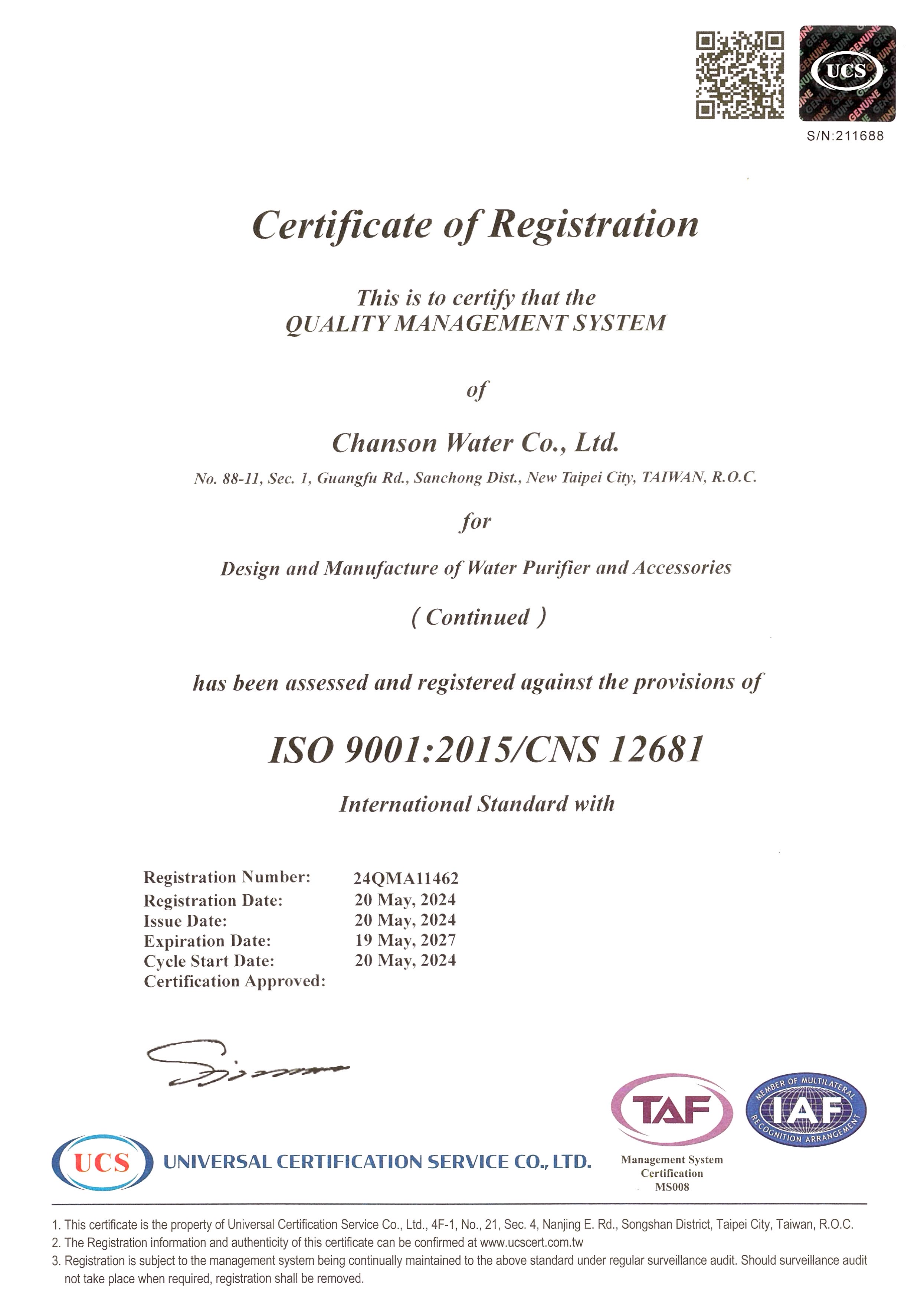
ISO 9001 relates to quality-management systems.
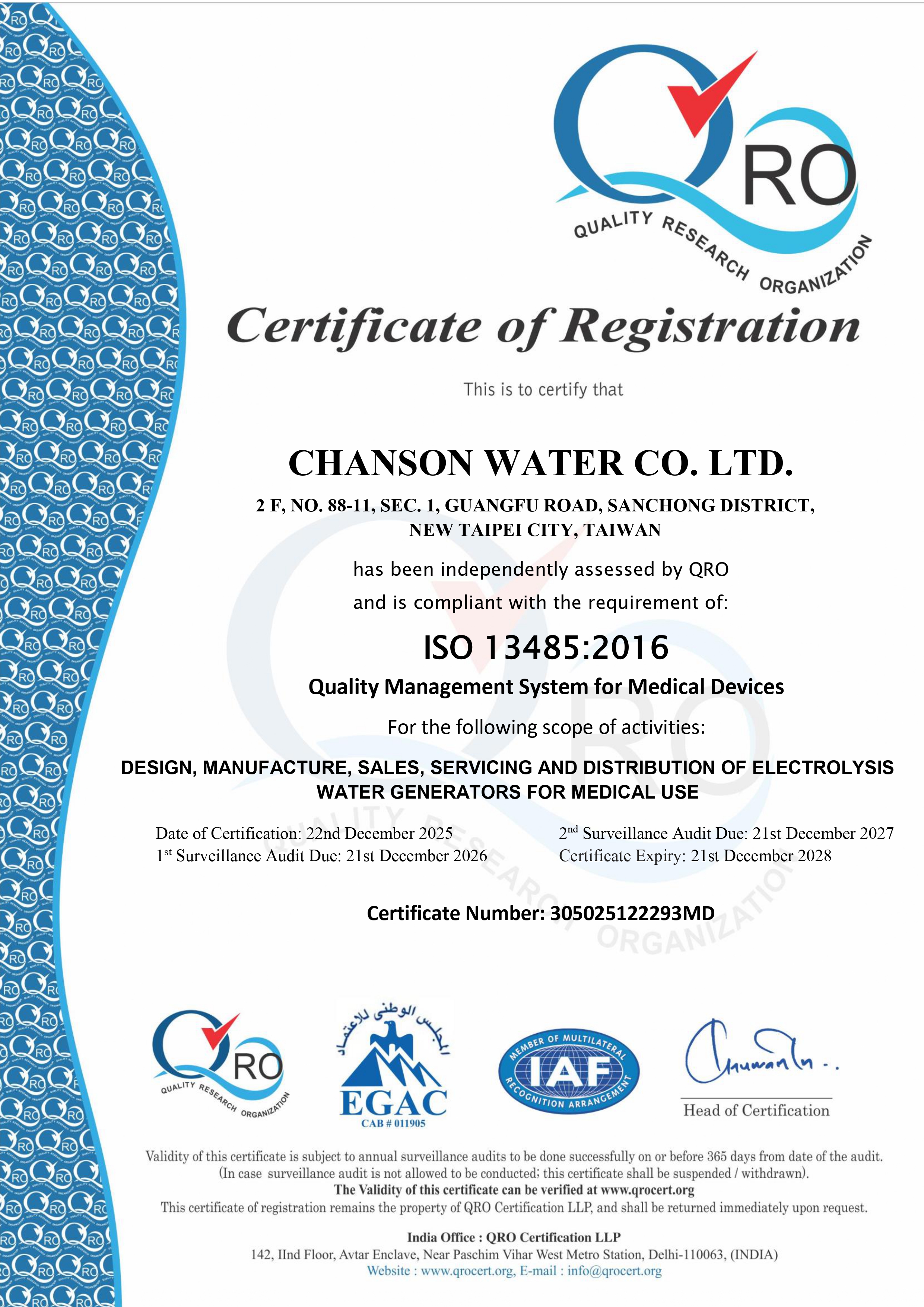
ISO 13485 is a quality-management standard specifically associated with medical devices.
WQA certifications or certifications associated with filtration components can provide information about applicable water-treatment performance or product requirements.
FDA terminology also needs to be checked carefully. “FDA registered,” “FDA listed,” “FDA cleared” and “FDA approved” do not necessarily mean the same thing.
Therefore, when evaluating a Kangen water machine, buyers should verify:
Which organization issued the certification
Which exact model is covered
What component or claim the certification applies to
Whether the certification is current
Whether the manufacturer provides documentation
A certification should support a specific quality or compliance claim rather than being used as a general statement that a machine is “better.”
10. Warranty and After-Sales Support
A long warranty can provide useful reassurance, but the number of years alone doesn't tell the whole story.
When comparing a Kangen water machine, buyers should check whether the warranty covers:
Complete machine
Electrolytic plates
Internal electronics
Filter system
Installation
Labour
Replacement parts
It is also worth checking whether service is available in the buyer's city and how quickly replacement filters or parts can be delivered.
A slightly more expensive machine with accessible local service may provide better overall value than a cheaper machine that becomes difficult to maintain after installation.
11. Usability and Installation
The best Kangen water machine is not necessarily the one with the longest specification sheet. It also needs to be convenient to use every day.
Look for features such as:
Easy pH selection
Clear digital display
Touch controls
Child lock
Filter replacement indicators
Automatic cleaning
Error notifications
Automatic shut-off
Easy filter replacement
Installation type is another consideration.
Countertop installation
Countertop machines are generally easier to install and can be more convenient for renters or buyers who don't want to modify kitchen cabinets.
Under-sink installation
An under-sink Kangen water machine keeps the main appliance out of sight and can be more suitable for modern modular kitchens. The Chanson Miracle Max Royale, for example, is designed as an under-sink 7 plates model with a separate counter tap.
The buyer should consider available cabinet space, plumbing requirements, water pressure and installation costs before choosing between the two formats.
Also Read: Health Benefits of Kangen Water Machine?
Kangen Water Machine Price in India: What Determines Cost?
The Kangen water machine price in India can vary considerably depending on plate count, filtration, installation format, electronics, hydrogen specifications, warranty and after-sales support.
Current Chanson pricing illustrates how machine configurations can vary, with listed prices including ₹1.09,000 for the Miracle Max Lite 3 plates, ₹1,78,000 for the Lite 5 plates, ₹2,47,000 for the Miracle Max Plus 7 plates, ₹3,59,000 for the under-sink Miracle Max Royale 7 plates and ₹3,10,000 for the Miracle Max Revolution 9 plates. Prices can change, so buyers should confirm the current price before purchasing.
Several factors contribute to the price.
Plate configuration
Higher plate counts and more advanced electrolytic designs can increase manufacturing cost.
Filtration
Advanced multi-stage filtration and certified filter systems can affect the overall price.
Installation
Under-sink systems may cost more because they require different plumbing and installation arrangements.
Electronics and controls
Touchscreens, automatic cleaning, sensors, error notifications and programmable settings can add to the machine's cost.
Warranty and service
Longer warranties and stronger service networks can also contribute to the overall price.
Instead of comparing only the purchase price, buyers should calculate the total cost of ownership.
That includes:
Purchase price + installation + replacement filters + servicing + replacement parts
A machine with a lower upfront price may not necessarily be cheaper over five or ten years.
What Is the Right Kangen Water Machine for Your Home?
There is no single Kangen water machine that is ideal for every buyer.
A smaller household may prioritize affordability, compact countertop installation and basic ionization.
A medium-sized family may prefer a 5- or 7-plates system with stronger filtration, higher flow capacity and a longer warranty.
A larger household, clinic, office or wellness facility may have a greater need for higher flow rates and higher-capacity electrolysis systems.
Buyers should therefore match the machine to actual usage rather than paying for specifications they will never use.
Comparing Chanson Alkaline Ionizers
Once the important features are understood, comparing individual models becomes much easier.
*Prices and specifications can change. Confirm the current manufacturer specification before purchase. Chanson's current product pages provide the latest model-specific information.
The comparison shows that the models are positioned for different requirements rather than representing a simple good-better-best hierarchy. The Lite 3 focuses on entry-level use, while the Lite 5 provides a middle option. The 7-plate models add higher specified hydrogen output and greater electrolysis capacity, while the 9-plate Revolution offers the highest stated flow rate in this range.
How to Make the Final Decision
Before buying a Kangen water machine, start with the water that is actually available in the home.
If the source water has high hardness or other quality concerns, determine whether additional pre-treatment is required. Next, estimate how much water the household uses each day and choose a suitable flow rate.
Then compare the technical specifications:
Filtration
Plate configuration
pH settings
Hydrogen output
ORP
Flow rate
Cleaning system
Certifications
Warranty
Service availability
Filter replacement cost
A live demonstration can also be useful, particularly if the manufacturer can test the machine using the buyer's actual water supply. Buyers should ask how the pH, hydrogen and ORP measurements were obtained rather than relying on a single number presented without testing conditions.
Conclusion
The most important features to evaluate in any Kangen-style water ionizer are filtration quality, plate count and material, adjustable pH range, hydrogen and ORP output, self-cleaning capability, certifications, warranty coverage, and after-sales support. Rather than focusing on brand name alone, buyers who compare machines feature-by-feature — and see a live demonstration before purchasing — are far better positioned to choose a unit that fits their household's water quality, usage needs, and budget for years to come.
This article is for informational purposes. Product specifications, certifications, and pricing should always be verified directly with the manufacturer or retailer before purchase, and individuals with medical conditions should consult a physician before making significant changes to their water consumption.
Latest Blog
-
21 Sep 2026
Is Your Water Ionizer Truly Medical Grade? (ISO 13485 & FDA Explained) -
14 Sep 2026
The Truth About Water Ionizer Prices: MLM Markups vs. Direct-to-Consumer -
29 Aug 2026
Top Features to Look for in a Kangen Water Machine -
16 Aug 2026
Best Water Ionizers With Low Maintenance Cost in India 2026 -
04 Jul 2026
Kangen Water Machine Price in India (2026): Model-Wise Price List, Features & Affordable Alternatives -
20 Jun 2026
How Does a Hydrogen Water Bottle Generator Work? A Complete Beginner's Guide -
16 May 2026
What Are the Health Benefits of Using a Kangen Water Machine?

All Rights Reserved. © 2019-2026, Centrepoint Lifestyle Products Pvt Ltd.
